超簡単やり直し英語:Adverbs in Manner が使えるとかっこいい!


You can 2020 の超簡単やり直し英語 15

やり直し英語に一人で頑張っている人を応援するために、今日は、かっこよく英語を喋るためにうまく副詞と使えるようになってもらいましょう!次の Youtube には 20 個の副詞 adverbs in manner が出てきますが、全てご存知でしょうか?(youcan2020.comへ)

注意点はただ一つだけ!副詞の位置です。簡単なようで使いこなすには慣れが必要です。

◯ She read the letter carefully. 目的語の後は◯です。
◯ She carefully read the letter. 動詞の前も◯です。
✖️ She read carefully the letter. その間は✖️です。この感覚に慣れてください。

1 anxiously= a worried or nervous way, or an impatient way
2 awkwardly= not graceful or elegant 決まり悪そうに
3 calmly= relaxed and not agitated, at peace
4 cautiously= carefully in a reserved way to avoid dange
5 deliberrately= intentionally on purpose わざと

6 eagerly= excited about something しきりに
7 faithfully=  something is reliable 誠実に
8 foolishly= to describe an action that was stupid 馬鹿げたことに
9 frantically=  to take a lot of quick action nervously 半狂乱で
10 gently=  to do something with soft, delicate, careful movements

11 hastely= quickly or fast 大急ぎで
12 irrtablly=  to demonstrate your annoyance or slight anger イラついて
13 painfully= to hurt physically or an confortable feeling 痛々しく
14 poorly=  badly ひどい 散々な * 貧乏とは関係ありません!
15 promptly=  without delay or on time ちょうど、直ぐに

16 recklessly=  not careful 無鉄砲に、むやみに
17 reluctantly=  don’t really want to do いやいやながら
18 repeartedly=  to happen again and again 繰り返し、何度も
19 smoothly=  to happen without difficulties 順調に
20 wildly=  in an uncontrolled way 乱暴に

最後にスペイン語も書いておきます。
1ansiosamente 2torpemente 3calmadamente  4cautelosamente 5deliberadamente 6ansiosamente 7fielmente 8absurdamente 9frenéticamente 10suavemente 11rápidamente 12irritablemente 13dolorosamente 14malo 15puntualmente 16imprudentemente 17reticentemente 18repetidamente 19favorablemente 20brutalmente

たった 20 個の副詞ですが、難なく使えるようになれば、会話がとてもスムーズになること間違いなしです。お試しください!

 You can 2020 はみなさんと一緒に東京オリンピックまでに世界とコミュニケーションが取れるバイリンガル国際人になることを目指します!誰にでもできます!可能です!必要なのは、自分でもやれそうかなと思い立つことだけ!(youcan2020.comへ)

毎日使える簡単 phrasal verbs:transient か intransient か?separable か inseparable ?


毎日使える簡単 phrasal verbs ④

phrasal verbs の勉強は面倒臭い!いくらやってもキリがないほど多い!覚えようとしてもすぐに忘れてしまう!色々な意味があってこんがらがると思っている人!多いと思います!先ずは次の動画をじっくりとご覧ください。無理なく基本的な phrasal verbs を身につけられるヒントが一杯です。(youcan2020.comへ)

phrasal verbs を使いこなすこつは、 ① transient or intransient (他動詞的に使われるか、自動詞的に使われるか)と ② separable or inseparable (動詞と前置詞 (副詞)の間に目的語を入れられるかどうか否か)を意識し、自分にとって重要で、日常生活の中で目にする phrasal verbs だけを例文とともに攻略していくことだそうです。

14 色々な意味がある put down:⑴ to place something down on the ground (地面に置く) ⑵ to humiliate or criticize someone (けなす、批判する) ⑶ to kill an animal that was sick or suffering (病気の動物を殺す)

15 go out:to leave your house (家を出る) 16 go after (that job):try to get something (手にする) 17 go together:to associate (付き合う)、compatible (両立する) 18 go away:to leave a place (離れる) 19 hang out with (friends):to spend time in particular place with particular people (ぶらつく)

20 look after (my nephew):to take care of someone (世話をする) 21 bring together:to introduce two people to each other (紹介する) 22 put (something) away:to put something in a place (ある場所に置くのほか、監獄に入れる、お金を貯める、たくさん食べるなど色々な意味がある)  23 look up to (inseparable):to respect someone (尊敬する) 24 grow up:to mature (成長する)

25 come over (intrasitive):to visit someone (訪ねる) 26 come over (transitive):if a strong feeling comes over someone,  they suddenly experience it. (強い感情に打たれる) 例文:A wave of sleepiness came over me.

27 take on:to become responsible for (責任を負う) 28 give up:to stop doing something (やめる) 29 put up:to make available for sale (販売用に並べるのほかにも色々な意味がありますので調べてみてください) 30 put up with (something):to accept an unpleasant situation (我慢する)

31 get on (the bus):(バスに乗る) 32 take off (in the plane):(離陸する) 33 pick up (the hire car):(ハイヤーを拾う) 34 pack up (your suitcase):(引き取る) 35 go out for (dinner):(夕食に出かける) 36 take over (dinner):to take control of something 37 clean up:to make something competely cearn (片付ける)

ブログやニュース、新聞や雑誌に出てくる prasal verbs を徹底的にマークしてみましょう!身近なところにあるものから、自分に関係するものから始めるのがいいと思います。Google 検索に調べたいphrasal verb を打ち込めばありとあらゆる例文が出てきます。

You can 2020 はみなさんと一緒に東京オリンピックまでに世界とコミュニケーションが取れるバイリンガル国際人になることを目指します!誰にでもできます!可能です!必要なのは、自分でもやれそうかなと思い立つことだけ!(youcan2020.comへ)

超簡単やり直し英語:聴けて、わかるが第一歩!


You can 2020 の超簡単やり直し英語 ⑥

外国語ができるってどういうことでしょうか?それは、何と言っても「聴けて、わかる」ということではないでしょうか!

言語は音と文字でできています。音のインプットが listening、音のアウトプットが speaking、文字をインプットするのが reading、文字をアウトプットするのが writing です。

中高 6 年間英語をやって英語が喋れない人は、input の量を増やすことが第一です。inputがなければ何の output も期待できません。とにかく listening と reading をやり直しましょう!

スクリーンショット 2018-12-13 9.58.16

英語は忘れた!単語が出てこないという人は、そもそも imput が足りなかったのでは!次回は先ず listening の秘訣からお話ししましょう!

You can 2020 はみなさんと一緒に東京オリンピックまでに世界とコミュニケーションが取れるバイリンガル国際人になることを目指します!誰にでもできます!可能です!必要なのは、自分でもやれそうかなと思い立つことだけ!

had been + ing は過去完了進行形です!


英語からスペイン語日常会話講義31

VOA の新しい Let’s Learn English シリーズ Level 2 の lesson 25 :  Only human! です。Lightning Bolt Lady goes looking for her superpowers. But will she ever find them? And will she ever help…anyone? 雷ボルトレディは超能力を探しにいきます。彼女は見つけることができるでしょうか?そして誰かを助けることができるでしょうか?

今回は past perfect continuous 過去完了進行形です。名前は難しいですが、次の文で理解できます。had been + ing です。 

To show that something started in the past and continued up until another time or action in the past 何かが過去に始まり、継続し、過去の他の時点や行為まで続く状況を表します。

① She had been walking into that wall for about 15 minutes when she had a great idea. 彼女が名案を思いついた時、すでに約15分間その壁に向かって歩いていました。

② Lightning Bolt Lady was happy because she had been using her superpowers all day.雷ボルトレディは幸せでした。なぜなら彼女は一日中超能力を使っていましたから。

③ The young man was surprised when Lightning Bolt Lady arrived because he had  not been waiting for her. 雷ボルトレディが着いた時、若者は驚いた。なぜなら彼は彼女を待っていなかったから。

過去完了進行形はスペイン語でも感覚的には全く同じです。

Ella había estado caminando hacia la pared durante unos 15 minutos cuando había tenido una gran idea.

Lesson 25 のテキストやより詳しい説明は、次の website をご覧ください。

https://learningenglish.voanews.com/a/lets-learn-english-level-2-lesson-25/4322773.html

You can 2020 はみなさんと一緒に東京オリンピックまでに世界とコミュニケーションが取れるバイリンガル国際人になることを目指します!誰にでもできます!可能です!必要なのは、自分でもやれそうかなと思い立つことだけ!

had better か would rather か!?


英語からスペイン語日常会話講義30

VOA の新しい Let’s Learn English シリーズ Level 2 の lesson 24 :  I feel super! です。Anna gets hit by lightning and, suddenly, can do amazing things. Or can she? アナは雷に打たれ、びっくりするようなことができるようになれる?今回は、〇〇したほうが良い had better と would rather の使い方です。ほとんど同じですが動画で確認してみましょう!

1 We use had better to give advice. It is very informal and stronger than should and ought to. * had better はアドバイスを与える時に使いますが、should や ought よりくだけた表現でつよい言い方になります。

例文:You’d better decide soon. Last year, it sold out. すぐに決めた方がいいよ。去年、売り切れたから!

2 We use would rather to say what we or someone else prefers to do or have. * would rather はよりやりたいことや持ちたいものをいう時に使います。

例文①: “Okay. If I had to choose, I’d rather be born a superhero. わかったよ!もし選ぶとしたら、スーパーヒーローに生まれたいなあ。* would rather の would も had better の hadと同じように人称代名詞と一緒に使われる時には短縮形になります。

例文②: I would rather be called Lightning Bolt Lady! 雷ボルトレディと呼ばれるのがいいかもしれない。

例文③:I’d rather go by myself. I’d rather walk. 私は一人で行こう。歩いて行くほうが良さそうだ!

Bot 教授が、より詳しい説明が、次の VOA で紹介されていますので、是非みてくださいといっています。

https://learningenglish.voanews.com/a/lets-learn-english-level-2-lesson-24/4307612.html

スペイン語では preferir という動詞を使って表現できるので迷いません。I’d better walk. も I’d rather walk. も Prefiero caminar. で ok です。

You can 2020 はみなさんと一緒に東京オリンピックまでに世界とコミュニケーションが取れるバイリンガル国際人になることを目指します!誰にでもできます!可能です!必要なのは、自分でもやれそうかなと思い立つことだけ!

二つの未来進行形は大丈夫ですか?


英語からスペイン語日常会話講義29

VOA の新しい Let’s Learn English シリーズ Level 2 の lesson 23 : Rock Star です。未来進行形 the future continuous verb tense です。will be 〜ing と be going to be 〜ing の二つの形があり、同じように使われます。日本人には意外と理解しやすい構文です。

①We use future continuous to talk about actions that will be in progress at or around a time in the future. There are two options for future continuous. 未来において進行するであろう行為、未来における一定の時間における行為について話すときに未来進行形を使います。

②The first is: will be + the –ingform of the verb 一つ目の方法は will + be + ing 形です。
例文:You’ll be interviewing musician Emma G. あなたが歌手のエマ G とのインタビューをやるだろう。Entrevistarás a la cantante Emma G. *スペイン語では単に未来形で ok だと思います。

③The second is: be + going to be + the –ing form of the verb. 二つ目の方法は be + going to be + ing 形です。
例文:I’m going to be teaching at a music camp in Chicago. 私はシカゴの音楽キャンプに行くことになっている。Voy a dar clases en un campamento de música en Chicago. * スペイン語では現在進行形を使って問題ありません。I’m going to teach at a music camp in Chicago. と同じになってしまいます。

④Future continuous is used only for action verbs. An action verb is a verb that expresses a physical or mental action. Examples are: write, read, sing, work, think and stop. Verbs like be, become, feel and look are not action verbs.

未来進行形には肉体的・精神的行為を表す動詞のみが使われます。例えば、write, read, sing, work, think, stop 等です。be, become, feel, look 等は未来進行形には用いられません。

Bot 教授が、より詳しい説明が、次の VOA で紹介されていますので、是非みてくださいといっています。

https://learningenglish.voanews.com/a/lets-learn-english-level-2-lesson-23/4287922.html

You can 2020 はみなさんと一緒に東京オリンピックまでに世界とコミュニケーションが取れるバイリンガル国際人になることを目指します!誰にでもできます!可能です!必要なのは、自分でもやれそうかなと思い立つことだけ!

Tell と Say の使い方も大丈夫ですか!


英語からスペイン語日常会話講義28

VOA の新しい Let’s Learn English シリーズ Level 2 の lesson 22 : Trash to Treasure, Part 2 です。tell と say の違いについてです。二つとも日本語では「言う」ですが!

①Tell means “to inform or instruct someone with words” and is almost always followed by an indirect object. * Tell は誰かに言葉を使って知らせたり、指示したりする意味。「〇〇に」と間接目的語を取る場合がほとんど!

Sue says, “Tell me about that.” スーは「それについて私に話してください」といった。* The word me is the indirect object and tells us who is being told. me が間接目的語で、誰に向かって話されているかを示しています。

②Say means “to express something with words” and focuses more on the words used. * Say は言葉を使って何かを表現する意味で、より使われる言葉に焦点が当たっています。When we use say, we do not focus on who is receiving the information. So, we do not use an indirect object. Say を使うとき、誰が情報を受けとっているかには焦点が当たっていません。だから間接目的語を使いません。

たとえば Anna says, “That’s what it said. It said, ‘Use me, Anna.’” アナは「まさにそれが語ったことなの」という。それは「私を使って、アナ」といった。という意味になります。

Bot 教授が、より詳しい説明が、次の VOA で紹介されていますので、是非みてくださいといっています。

https://learningenglish.voanews.com/a/lets-learn-english-level-2-lesson-22/4283017.html

なお、スペイン語で tell と say のような違いはなくdecir で大丈夫です。また、talkとspeak のような差もなく、全て hablar で問題ありません。

You can 2020 はみなさんと一緒に東京オリンピックまでに世界とコミュニケーションが取れるバイリンガル国際人になることを目指します!誰にでもできます!可能です!必要なのは、自分でもやれそうかなと思い立つことだけ!

Talk と Speak の使い方は大丈夫ですか!


英語からスペイン語日常会話講義27

VOA の新しい Let’s Learn English シリーズ Level 2 の lesson 21 : It speaks to me. です。 talk と speak の違いについてです。二つとも to say words 言葉を発するという意味ですが!

Anna wants to get Pete a gift for his birthday. So, she visits a store called Tanglewood Works and tries to learn the difference between trash and treasure… アナはピートの誕生日に贈り物を考えています。そして彼女は評判の upcycle shop の Tanglewood Works へ行きます。そこで trash と treasure、つまりガラクタからの宝物作りを体験します。

one-of-a-kind piece 「この世に一つしかない逸品」を作り出せるでしょうか!

*まず talk の使い方です。
①for conversations between two or more people:二人以上の間で
②and informal situations, such as between friends or family:友人や家族間のような硬苦しくない状況で

例文です。❶ Are you talking to yourself again? また独り言?❷ I was talking to Pete. ピートと話していたとこ! ❸ I can almost hear it talk. 私はガラクタが話しているのがだいたい聞こえるの!

*次に Speak の使い方です。
①for one-way communication, such as presentationsプレゼン等の一方的な発信 
②formal situations, such as a boss speaking with her workers:上司が部下と話す公的な状況で
③to talk about language ability語学の能力について話すとき
④in polite requests丁重な要望

例文です。❶ from the way he speaks, 彼の話しぶりからして ❷ speaking of Pete’s birthday, ピートの誕生日についてだけど、❸ Pick some trash that “speaks” to you. あなたに話しかけてくるゴミを拾いなさい。

いかがでしたか?talk と speak の nuance はわかりましたか?より詳しい説明が、次の VOA で紹介されていますので、是非研究してみてください。

https://learningenglish.voanews.com/a/lets-learn-english-level-2-lesson-21/4273059.html

You can 2020 はみなさんと一緒に東京オリンピックまでに世界とコミュニケーションが取れるバイリンガル国際人になることを目指します!誰にでもできます!可能です!必要なのは、自分でもやれそうかなと思い立つことだけ!

Direct speech と Reported speech をスペイン語と比較する。


英語からスペイン語日常会話講義26

VOA の新しい Let’s Learn English シリーズ Level 2 の lesson 20 The Test Drive です。直接話法 direct speech と間接話法 reported speech についてです。ただ単純に、たった今「〇〇といった」という場合には、that で繋げるだけで、わざわざ時制を一致させる必要もありません。

Anna, Penelope and Rick are making a news story about the Washington Car Show. Anna is having a lot of fun — maybe too much fun… アナはペネロペやリックと一緒に自動車ショーの収録に行きますが、面白すぎて大変なことに!

*話法については、スペイン語の場合も英語とほぼ同様ですが、スペイン語の方がより時制の一致に縛られます。

1 She said that we need to show lots of cars. → Ella dijo que tenía que mostrar muchos autos. *スペイン語の場合、主動詞の時制が過去であれば、reporting clause の動詞は、一つ遡り、自動的に過去形、または大過去形になります。tener que は have to の意。

2 People all over town are saying that if you like cars, this is the place to be. → La gente de toda la ciudad dice que si te gustan los autos, este es el lugar para estar. *普通は reporting clause の内容を that で結べば okです。

3 I was told that I could drive this course. → Me dijeron que podía conducir este curso. * reporting clause の動詞が can, must, have to の場合には必ず could, might, had to となります。

She asked if/whether I liked the Washington Car Show. → Ella me preguntó si me gustaba el Washington Car Show. * Yes か No を期待する疑問文の場合、主動詞は say ではなく ask となります。また、 that ではなく if/whether で reporting clause を結びます。スペイン語では si を使います。

より詳しい説明が、次の VOA で紹介されていますので、是非研究してみてください。

https://learningenglish.voanews.com/a/lets-learn-english-level-2-lesson-20/4254704.html

You can 2020 はみなさんと一緒に東京オリンピックまでに世界とコミュニケーションが取れるバイリンガル国際人になることを目指します!誰にでもできます!可能です!必要なのは、自分でもやれそうかなと思い立つことだけ!

時事英語:大谷くん、少年にバットをプレゼント!


中級英西時事ニュース講義25

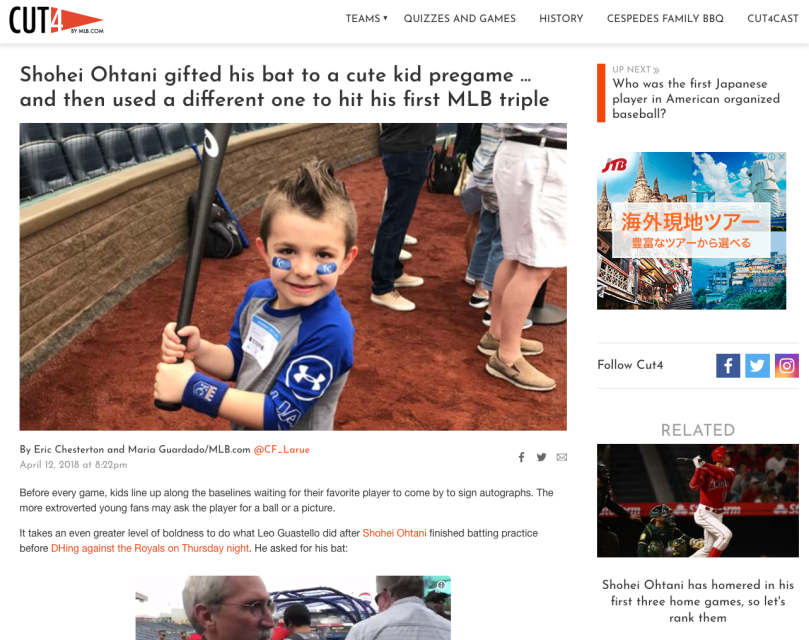
大谷選手が、相手チームのファンの少年にバットをねだられ、一旦は断るも、あとで気前よくプレゼント!そのあと出たのがメジャー初めての3塁打!やっぱりすごいですね!MLB の Cut 4 で楽しみましょう!タイトルは Shohei Ohtani gifted his bat to a cute kid pregame … and then used a different one to hit his first MLB tripleです。

①Before every game, kids line up along the baselines waiting for their favorite player to come by to sign autographs. The more extroverted young fans may ask the player for a ball or a picture. いつもゲームの前には子供達が、お気に入りの選手のサインを待って並んでいます。ちょっと気の強いファンは、ボールや写真をねだりますが!

スクリーンショット 2018-04-13 22.12.59

②He asked for his bat. この子はなんと大谷くんのバットをおねだり!最初はもちろんダメでしたが、そこは大谷くん “But I can’t be doing this all the time. I’ll run out of bats.” いつもこんなことはしないよ!バットがなくなっちゃうから!

③Ohtani is not only a great hitter and a great pitcher, but it looks like he’s also great with the fans. 大谷選手は、単に偉大なバッターであり、ピッチャーであるだけでなく、ファンに対しても偉大だ!

是非、下を click して楽しんでください。

https://www.mlb.com/cut4/a-kid-asked-for-shohei-ohtanis-bat-so-ohtani-gave-it-to-him/c-271970972

You can 2020 はみなさんと一緒に東京オリンピックまでに世界とコミュニケーションが取れるバイリンガル国際人になることを目指します!誰にでもできます!可能です!必要なのは、自分でもやれそうかなと思い立つことだけ!